
Doesn't it sometimes feel as if every company has its own podcast? Perhaps you've even grown tired of them. Is it still possible to succeed? Tale's podcast producer Emelie Omnell explains how to create a podcast that actually works – and that becomes a strategic tool as well.
Many company podcasts barely get more than ten listens. Perhaps because there are too many half-hearted efforts. When the content is unclear or uninteresting, it is hard to cut through the noise.
Ambition is rarely the problem. Companies want to strengthen their position and take a leading role in their industry. The challenge is rather that they don't set a clear framework from the start – both for how the podcast should be designed and for how it connects to the overall strategy. Instead it becomes a side project that fizzles out.
I may be biased as a podcast producer, but I still think podcasts are a fantastic format. Partly because they leave room for real reasoning, not just a polished surface, and partly because it is such a personal format where you get really close. More companies should have podcasts – but good ones.
Here is what matters most if you want to use a podcast as a strategic tool.

Podcasts are one of the few formats that leave room for depth, and where listeners are prepared to stay and listen (if they like the content, that is). In a world where communication moves faster than ever, there is value in developing ideas and showing how you actually reason.
For companies in complex industries, that can be crucial. Sharing choices and perspectives builds understanding and trust among listeners in a completely different way than short posts in a feed.
Convinced it's time to start a podcast? Good, let's continue.

Before you buy equipment or start soundproofing a meeting room, you need to settle on purpose and format. Start by setting clear goals. What do you want to achieve, what do you want to stand for, and which issues do you want to drive over time?
Not least, review your overall strategy and how you can align the podcast with it. Perhaps your strategic goal is to take a clearer role as an expert adviser in your industry. Perfect – then the podcast should be designed to strengthen exactly that position, and in the longer term it becomes a strategic tool.
It is also important to decide what type of podcast you want to make and stick to it, rather than mixing different formats at random. Consistency in both content and format makes it easier for listeners to understand what the podcast is and gives them a reason to come back when they know what to expect.
Some common formats are:

Thought leadership doesn't happen in a single episode. It is long-term work in which you repeatedly contribute to conversations and build a clear position over time.
That is why it is important to be clear from the start about which topics you want to own and which issues you actually want to take a stand on. Otherwise the podcast risks losing focus and direction. When the content is anchored in your strategy and brand identity, it strengthens your relationship with your most important audiences. That builds a trust that is hard to achieve in shorter formats.
In several podcasts we produce, a key person at the client is the host – often a CEO or another senior representative. By inviting relevant people from the industry, sometimes existing customers and sometimes potential ones, you create conversations that are both valuable in themselves and relationship-building.
Inviting a potential customer to a conversation is a natural way to open doors. The guest gets the chance to share their knowledge, while the host can contribute their perspective and take a position on issues that matter to the industry. It is also a good opportunity to broaden your network. That way the podcast becomes both a platform for sharing knowledge and a concrete business tool.
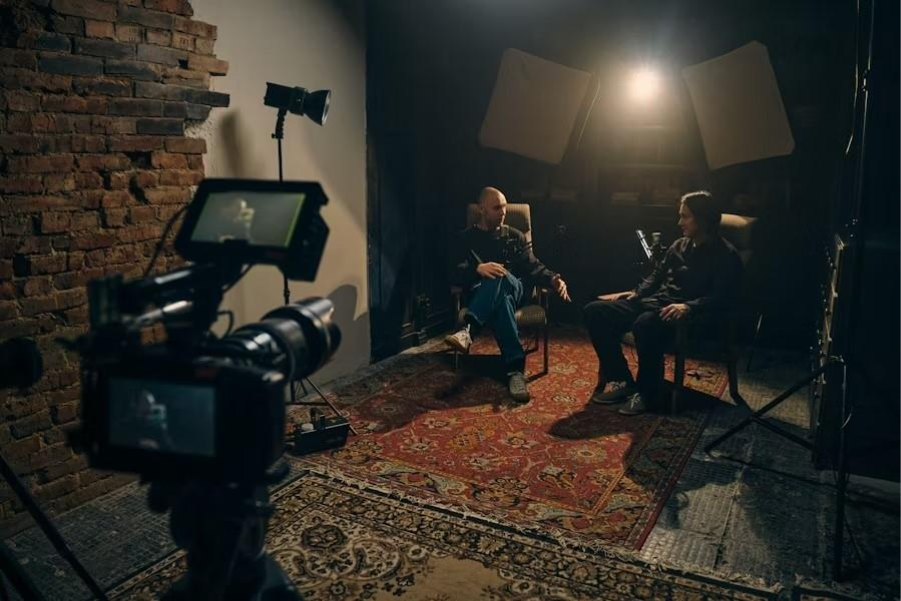
A very effective way to kill two birds with one stone. You can experiment with how much you want to record. Some record the whole episode and put it on YouTube in full. Others only film parts of the conversation to cut into clips for social media.
It is a powerful way to cut through the noise. We humans are highly visual, and moving images often get more attention in social feeds than still images or audio alone. That is why it is often an advantage to film at least parts of the conversation, even if the main format is a traditional podcast.
A well-planned podcast doesn't end when the episode is published. If the content is planned with a broader perspective, it can live on in several formats.
At Tale we often work according to a newsdesk model. Put simply, it means starting with the story and then adapting it for different channels, such as video, articles or a LinkedIn post. A conversation can become an article. Parts of the episode can be cut down into shorter social media videos. That also gives the podcast a bigger life than “just” being a podcast.
In the end, it isn't the amount of content that matters, but its relevance and your ability to keep going over time. The most important thing is to be consistent and not lose momentum. Plan a clear season, for example six well-crafted episodes, so that listeners experience continuity and want to keep following along.
OK, you've published your podcast. But it won't make a difference if nobody finds it. That is why distribution needs to be a natural part of the planning.
Paid advertising is most effective, combined with organic activity for wider reach. A common approach is to use short video clips that spark curiosity on social media, or to add an article on your website that goes deeper. It can also mean pitching the podcast to relevant media or inviting guests with strong networks of their own who can help spread the content.
When content and distribution work together, the chances increase that your podcast isn't just published, but actually listened to.
Contact me if you want to bounce ideas around or have questions: emelie.omnell@talecontent.se
Tale är en content- och PR-byrå inom Diplomatgruppen. Vi hjälper företag och organisationer att utveckla sin kommunikation genom content, PR och storytelling.
Vi kommer oftast in när kommunikationen är komplex och det måste bli rätt, till exempel vid strategiska skiften, känsliga frågor eller när något riskerar att bli medialt.
Det gör att ni kan fatta beslut och kommunicera på ett sätt som håller internt och externt.
