
How many times have you opened LinkedIn and felt the feed is full of posts that are just too perfect? Perhaps you already react to overused semicolons, long dashes or a tone that is strangely flawless. Here we list the most common pitfalls we see when AI is used without clear editorial judgement.
If you want to come across as yourself, with a voice that is genuinely yours, it's worth reading on. We're not saying you should stop using AI – quite the opposite. Today most communications departments need to work with AI to stay competitive. The pace is high and the demand for content outstrips the resources.
The point is not to opt out of AI, but to become more aware of when it shows too clearly. You will also stand out more if you use your own voice in LinkedIn's feed of polished posts. Correct, and be your own editor. Use this list to help you!
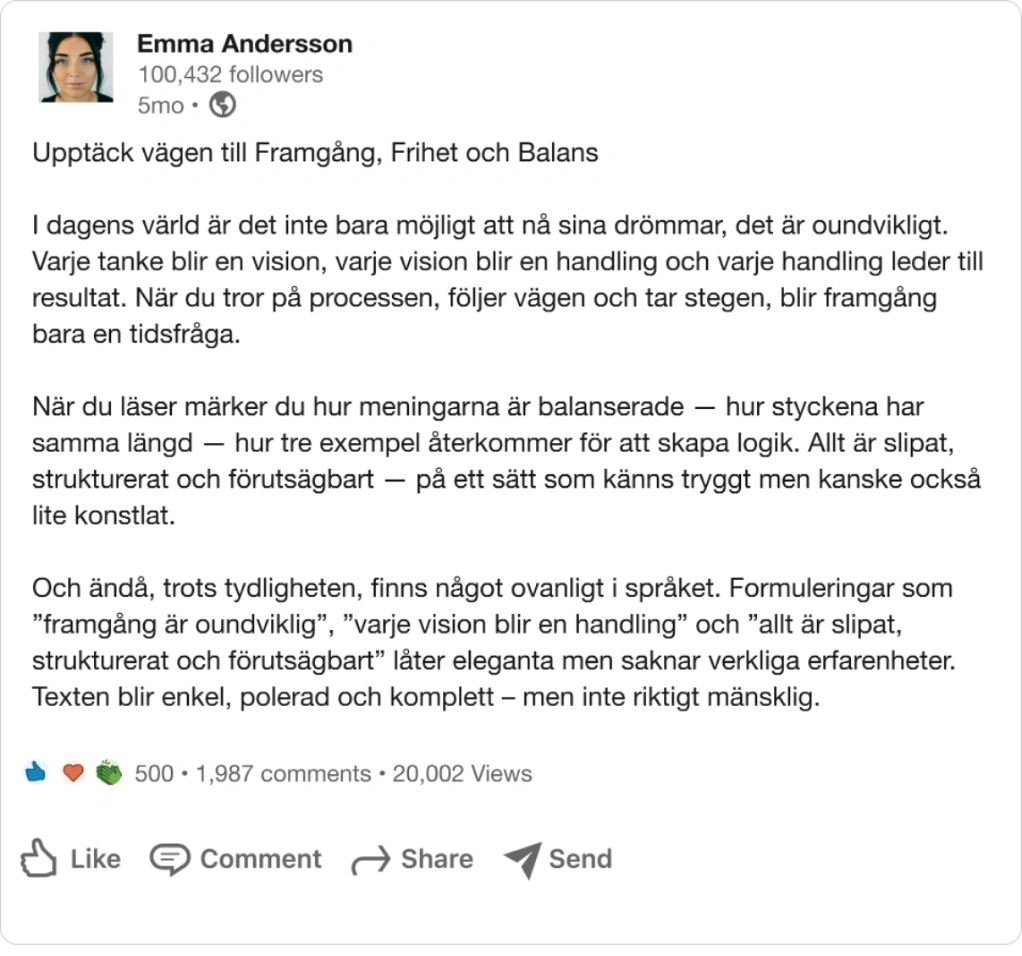
AI loves balance. You've probably seen it on LinkedIn. Arguments are built symmetrically and the number three keeps coming back: three arguments, three paragraphs or three value words in a row. The paragraphs are the same length and the sentences equally well balanced.
The result is linguistically correct and tidy, but also predictable.
Try:
Many AI texts open with an explanatory first sentence that tells you what is coming. Then follows a segmented, almost templated argument. Common features are dramatic short sentences, sometimes just one or two words for effect. Rhetorical questions that add nothing. Summaries that repeat what has already been said. It is communicatively correct. But often heavy-handed.
Try:
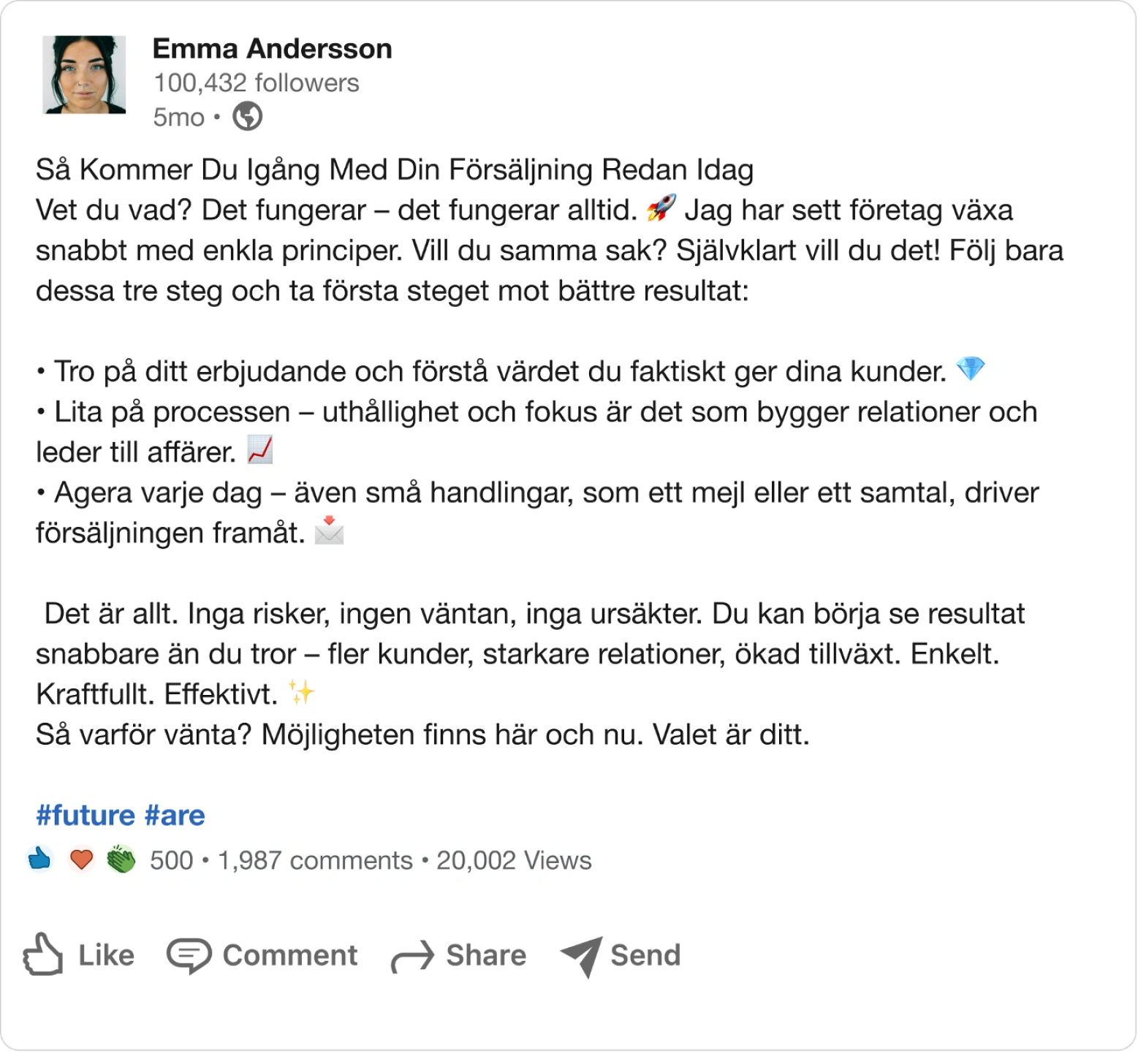
AI likes to package content neatly – almost too neatly. Bullet lists with bold words, pre-formatted bullets, clear subheadings and emojis to lighten the mood. It looks polished.
At the same time, certain linguistic signals keep recurring: overuse of dashes, unnatural capitalisation in headings, buzzwords and clichés, bold words, three examples in a row placed almost mathematically, and a generous helping of emojis. Each detail may be reasonable on its own, but together they drown out the voice. The text becomes correct, but impersonal.
Try:
The clearest signal is often that the text lacks weight. It sounds reasonable, but not lived. You can tell because none of the concrete insights seem to have cost anything to put into words.
AI can summarise what is being said in an industry. But it cannot replace experience of real decisions, conflicts or trade-offs.
Try:

Another pitfall is that the text becomes longer than it needs to be, because the arguments are allowed to sprawl, every perspective is included and every thought is explained in minute detail. The result is a text that is hard to disagree with, but also hard to remember – precisely because it doesn't prioritise or sharpen anything.
Human editing often does the opposite: cutting what is superfluous, shortening the argument and sharpening the wording until only what is essential remains.
Try:
In an AI-driven communications landscape, editorial judgement is the real competitive advantage. That is where priorities are set and someone takes responsibility for the whole.
It is about daring to write shorter, cutting what is superfluous and accepting that a text doesn't have to be perfect to be credible. The human element, with its clear positions, is often what makes a text actually stick.
Want to develop how you work with AI?
Contact me at emelie.omnell@talecontent.se
Tale är en content- och PR-byrå inom Diplomatgruppen. Vi hjälper företag och organisationer att utveckla sin kommunikation genom content, PR och storytelling.
Vi kommer oftast in när kommunikationen är komplex och det måste bli rätt, till exempel vid strategiska skiften, känsliga frågor eller när något riskerar att bli medialt.
Det gör att ni kan fatta beslut och kommunicera på ett sätt som håller internt och externt.
